September 14, 2026
 18 Min
 No Comment
Introduction: Why Businesses Are Looking for Simpler UPI Payment Solutions
I’ve watched UPI completely change the way customers and businesses make payments in India. Customers can pay directly from their bank accounts with a UPI app while merchants can receive money without relying on card terminals or complicated payment steps.
UPI supports merchant integration methods, such as QR based payments, UPI Intent, application based integrations and Collect flows. NPCI also says that UPI transactions are meant to work and all the time.
For businesses, freelancers, teachers, creators, online sellers and startups the biggest challenge is usually not using UPI itself. The real challenge is finding a payment solution that’s simple to start, affordable, easy to integrate and can automatically confirm orders.
That’s where a modern UPI payment gateway or UPI payment infrastructure solution can be useful.
One interesting model is a UPI solution that lets payments go straight to the merchant’s UPI account instead of acting like a normal payment aggregator.
The published UroRelay model for example highlights No KYC Needed, Zero Commission, instant settlement, SMS confirmed orders, unlimited webhooks and a plan that is free forever.
This combination is especially appealing for businesses that want to start accepting UPI payments without adopting a traditional payment gateway structure.
What Is a UPI Payment Gateway?
A UPI payment gateway is a technology layer that helps a business accept UPI payments from customers through its website, application, payment link or QR code.
Depending on the solution customers may be able to scan a QR code use a payment link approve a UPI payment request or finish a UPI based checkout.
A traditional payment aggregator may provide payment methods such, as cards, net banking, wallets and UPI while a UPI focused solution may concentrate specifically on UPI payments.
The distinction is important because the infrastructure, onboarding requirements, pricing and settlement model can be different.
For businesses that mainly receive UPI payments a focused UPI solution can sometimes give a simpler experience.
No KYC Needed is one of the important features for small online sellers and early‑stage businesses.
Traditional payment aggregators generally have merchant onboarding and verification processes because they provide a payment‑aggregation service. Merchants may need to submit business, bank and identity‑related documentation before being activated.
That process makes sense for a payment‑aggregation infrastructure particularly when a provider is handling payment routing and settlement on behalf of merchants.
Not every seller needs that model.
A UPI‑first solution such as UroRelay describes itself as a relay than a payment aggregator. According to its published information customer payments go directly to the merchant’s UPI account while the service generates payment links or buttons and can read the UPI credit SMS to confirm orders.
Because the provider does not position itself as an intermediary that pools the merchant’s funds its published model says No KYC Needed.
This can be particularly useful for:
- Freelancers starting a service.
- Tutors selling courses.
- Creators selling products.
- Small Instagram and WhatsApp sellers.
- Developers selling templates or software.
- Solo consultants.
- Early‑stage entrepreneurs testing a business idea.
For these businesses waiting for a merchant onboarding process can create unnecessary friction when the immediate requirement is simply to accept UPI payments.
No KYC Does Not Mean No Responsibility
It is important not to misunderstand this feature.
No KYC Needed should not be interpreted as “businesses have no tax responsibilities.”
KYC requirements can depend on the payment model, provider structure, merchant category and applicable regulations.
A merchant remains responsible for complying with laws, taxation requirements, consumer‑protection rules and business obligations.
The advantage of an UPI model is primarily that the payment service itself may not require the same merchant‑onboarding process as a traditional payment aggregator.
Zero Commission: Why It Can Make a Major Difference
The second major feature is Zero Commission.
Traditional payment platforms may charge merchants a percentage of every transaction depending on the payment method, provider, merchant category and commercial agreement.
Even a small percentage can become significant when transaction volume increases.
For example imagine a seller generating ₹2,00,000 in monthly UPI sales.
If a provider charges a percentage of every transaction the total payment‑related cost grows with revenue.
A zero‑commission model works differently.
Under the published UroRelay model the customer pays directly into the merchant’s UPI account. The merchant keeps the payment amount without a transaction commission. Instead the service uses a plan‑based pricing structure.
This distinction is extremely important.
Zero commission does not necessarily mean every feature is free.
A platform can charge a fixed subscription while still charging zero transaction commission.
That can actually be attractive for growing businesses because payment costs become more predictable.
Zero Commission vs Percentage‑Based Payment Fees
Consider a business processing ₹5,00,000 in payments.
With a model the payment cost increases as sales increase.
With a subscription model the monthly platform fee can remain fixed while the business processes more payments within its plan limits.
This means that a zero‑commission model can become particularly valuable for businesses with transaction volume.
It also makes pricing easier to understand.
Of calculating a percentage on every order the merchant knows the platform subscription and keeps the remaining transaction value.
Why Zero Commission Is Particularly Valuable for Businesses
Small businesses often operate on tight margins.
A digital‑product seller may have no incremental delivery cost after creating the product.
A tutor may sell a course repeatedly.
A consultant may collect payments for appointments.
An ecommerce seller may already have product, logistics and advertising expenses.
In cases transaction fees can gradually reduce profitability.
A Zero Commission UPI payment model can help merchants retain more of their sales revenue subject, to the provider’s plan limits and terms.
Instant Settlement: Get Paid Directly to Your UPI Account
Another advantage of a direct UPI model is instant settlement.
NPCIs UPI FAQ states that merchant funds can be received immediately after a payment subject to the merchants arrangement with the acquiring bank.
The UroRelay model takes this a step further by describing payments as going to the merchants own UPI account rather than being held in an intermediary settlement cycle.
This can be valuable for businesses that need access to their revenue.
A freelancer can receive payment immediately.
An online tutor can confirm a students payment quickly.
A small seller can process an order without waiting for a settlement cycle.
A creator can receive payment directly into the linked account.
For cash-flow- businesses, faster access to collected revenue can make day-to-day operations easier.
SMS-Confirmed Orders: Turning a Payment Into an Automated Order
Receiving money is one part of ecommerce payment processing.
The next challenge is knowing whether the customer has actually paid.
This becomes especially important when businesses sell products or services through their websites.
The published UroRelay model uses the UPI credit SMS received on the merchants phone as a payment confirmation signal. With the Companion Android app installed the system can detect the credit SMS. Confirm the order automatically.
This feature is called SMS-confirmed orders.
Of manually opening a banking application and checking every transaction the payment confirmation can trigger the order-confirmation process.
That can reduce reconciliation and make the checkout workflow faster.
How SMS-Confirmed Orders Can Help Ecommerce Sellers
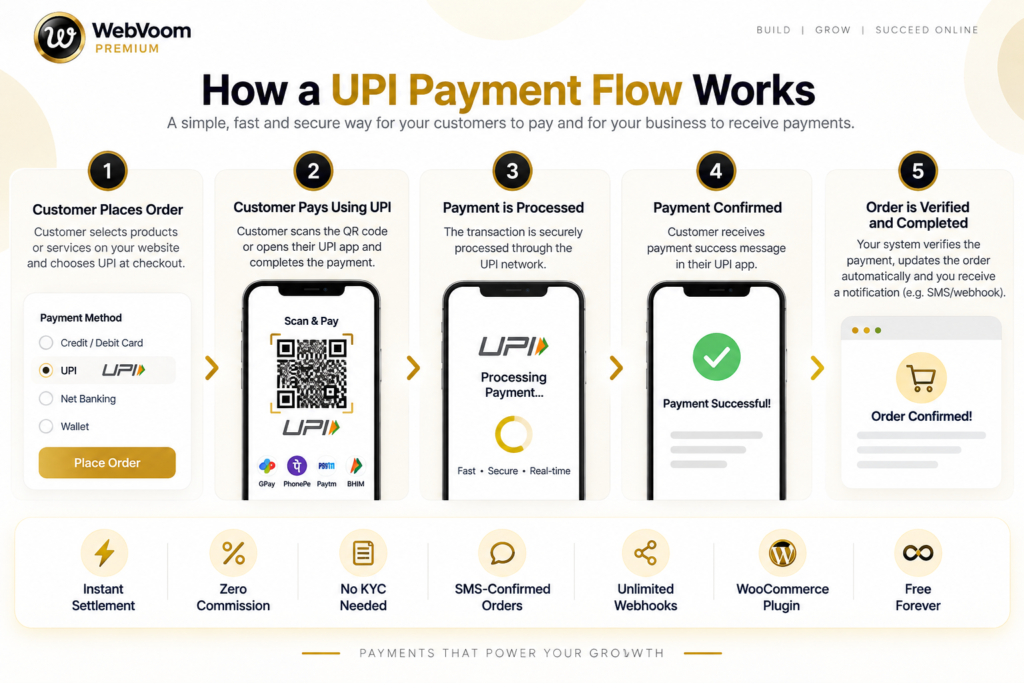
Imagine a customer purchases a product from an online store.
The customer scans the UPI QR code. Completes the payment.
The merchant receives the banks UPI credit SMS.
The companion system detects the payment confirmation.
The order can then be marked as paid according to the configured workflow.
This type of automation can be especially useful when a merchant receives small UPI payments throughout the day.
Without automation the seller may need to match payment references with customer orders.
With automated confirmation the reconciliation workload can be reduced.
What Happens If the Merchant Does Not Use the Companion App?
The published UroRelay documentation also describes a flow in which the customer enters the UPI reference number after completing the payment.
This means the payment process does not necessarily depend entirely on the SMS-reading workflow.
The important concept is that payment confirmation needs a signal before an ecommerce system marks an order as paid.
Unlimited Webhooks: Why Developers Care About This Feature
For developers Unlimited Webhooks can be more important than a payment screen.
A webhook allows a payment system to notify another application when an event occurs.
For example a successful payment can trigger:
- Order confirmation.
- Digital product delivery.
- Membership activation.
- Course enrollment.
- Invoice generation.
- CRM updates.
- Inventory changes.
- Email notifications.
The published UroRelay pricing information states that unlimited webhooks are included across its plans, including the plan.
This can be useful for businesses building automated workflows.
How Unlimited Webhooks Can Improve Automation
Consider an education website.
- A student pays ₹999 for a course.
- The payment event reaches the website through a webhook.
- The website confirms the payment.
- The student’s account is upgraded.
- The course becomes accessible.
- An email can be triggered.
The transaction can be recorded in the business database.
All of these processes can happen without a staff member checking the payment.
This is where payment infrastructure becomes more than a QR code.
It becomes part of the business automation system.
WooCommerce Plugin: Why WordPress Store Owners Need It
WooCommerce is one of the popular ecommerce platforms built on WordPress.
For a WooCommerce merchant integrating a payment method should ideally be simple.
Of manually developing a complete UPI payment workflow a plugin can connect the payment functionality with the WooCommerce checkout process.
The published UroPay ecosystem lists a WooCommerce plugin as one of its developer resources.
This can make UPI acceptance accessible to WordPress store owners.
A merchant can focus on products, customers and marketing while the payment integration handles the transaction workflow.
Free Forever: Why the Free Plan Is Useful for Testing
The Free Forever concept can be particularly valuable for entrepreneurs who are still validating a business.
According to the published UroRelay pricing page the Free plan costs ₹0 per month. Includes up to five unique transactions per month one Android device, limited payment links and payment buttons unlimited webhooks and free-forever access.
This means a business can test the payment workflow before committing to a paid subscription.
- A creator can test a sales.
- A freelancer can test client payments.
- A new website can test its checkout.
- A developer can experiment with webhook-based automation.
- This is a lower-risk way to evaluate a payment solution.
What Does Free Actually Mean?
“Free forever” should always be understood according to the providers published plan limits.
It does not mean transactions or unlimited access, to every premium feature.
In the published UroRelay plan the free tier has a transaction limit while higher plans increase the transaction allowance and payment-link/button limits.
Therefore businesses should select a plan according to their payment volume.
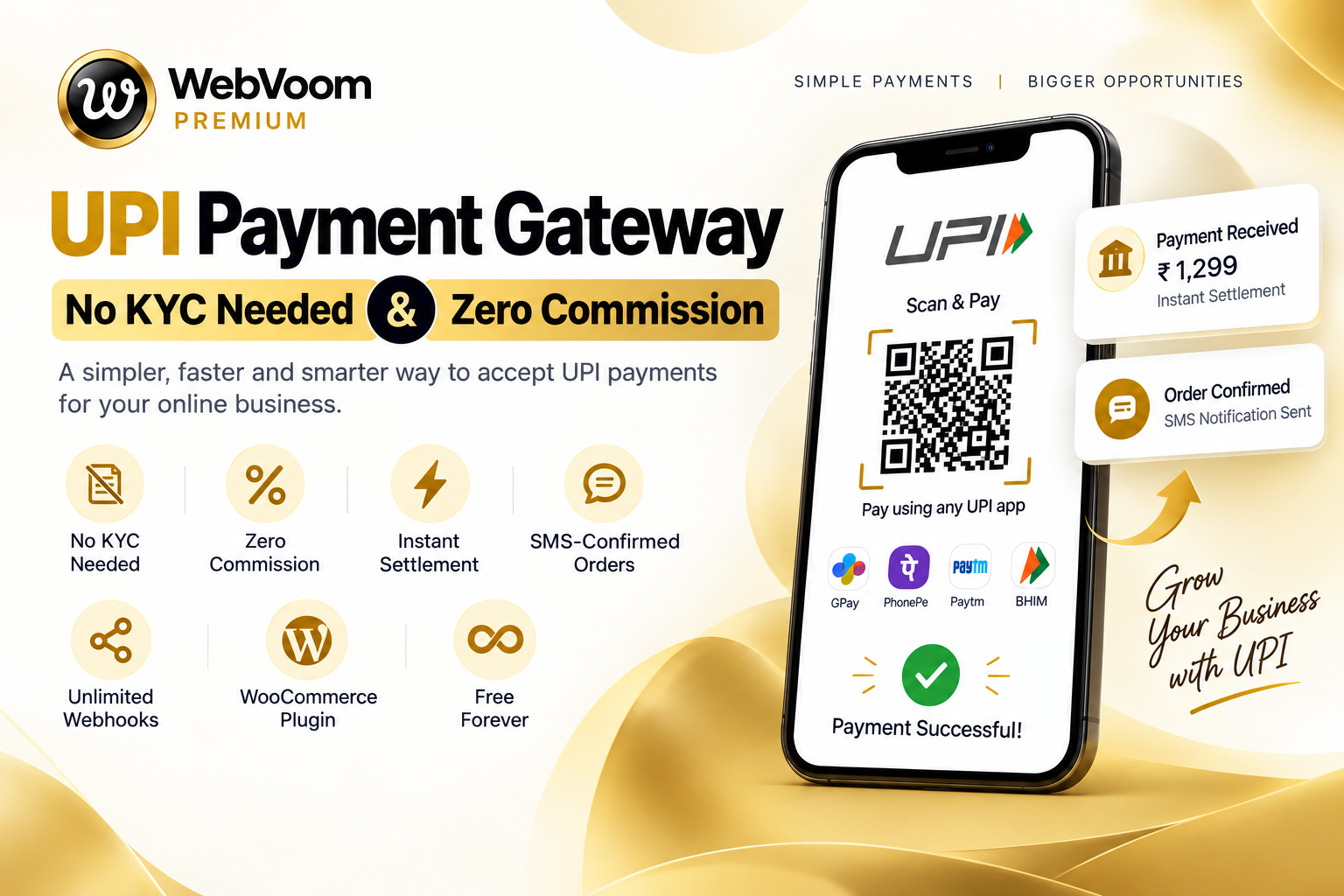
UPI Payment Gateway Features at a Glance
| Feature | How It Helps Businesses |
| No KYC Needed | Reduces onboarding friction for the published direct-UPI model |
| Zero Commission | Helps merchants keep the full transaction value instead of paying a percentage commission |
| Instant Settlement | Payments go directly to the merchant’s UPI account under the described model |
| SMS-Confirmed Orders | Helps automatically identify successful payments through UPI credit SMS |
| Unlimited Webhooks | Enables payment-triggered automation across websites and business systems |
| WooCommerce Plugin | Helps WordPress/WooCommerce stores integrate UPI payments |
| Free Forever | Allows eligible merchants to test the free plan without a monthly subscription |
| Payment Links | Allows merchants to collect payments through shared links |
| Payment Buttons | Allows merchants to embed UPI payment options on websites |
The exact availability and limits of features should always be checked against the provider’s current pricing and terms.
Payment Links for Businesses Without a Full Ecommerce Website
Not every business needs an ecommerce website to sell its products or services.
Some freelancers sell through WhatsApp.
Tutors use Instagram to connect with students.
Consultants send emails to talk with clients.
Creators promote their offerings on media platforms.
For these kinds of businesses payment links are a way to collect money without needing a full checkout system.
The UroRelay product offers payment links that can be shared on Instagram, WhatsApp, Facebook and email.
This makes it a good fit for businesses that run on commerce.
Why a UPI-First Payment Model Can Be Attractive
In India UPI is the way people pay.
UPI QR codes are interoperable. That means customers can use any UPI app they have to pay a merchant.
Bank-provided UPI services often highlight this interoperability as a feature.
So a UPI-first payment solution works well for businesses whose customers mostly use UPI.
It’s important to understand the limits.
A UPI- setup may not work if a business needs to accept cards, digital wallets, EMI, BNPL or international payments.
No KYC Needed vs Traditional Payment Gateway Onboarding
Traditional payment aggregators support a range of services. Multiple payment methods, merchant onboarding, risk checks and settlement.
Because of that they require documentation and verification.
A direct UPI model focuses on payments.
That narrow scope is why some UPI solutions can offer “No KYC Needed” while traditional gateways cannot.
So businesses should look at the payment architecture not just the marketing claims.
Zero Commission vs Low Commission
There’s a difference between “low commission” and “zero commission.”
A low-commission provider charges a percentage per transaction.
A zero-commission provider does not take any percentage fee under its stated plan.
For businesses with sales volume that difference can be significant.
For example if a business makes ₹10 lakh in UPI sales every month a 1% fee adds up to ₹10,000.. That’s before taxes or other charges.
A flat subscription with zero transaction fee can become more cost-effective as sales grow depending on the provider’s limits.
Security Considerations for UPI Payments
Convenience should never come at the cost of security.
Customers must always verify the merchant name and payment details before approving a transaction.
Businesses must protect their payment links, webhook endpoints, dashboards and API keys.
Webhook endpoints should check requests carefully. Not accept them blindly.
Businesses should keep transaction logs and reconciliation records for accuracy and audit purposes.
Customers must never share their UPI PIN with anyone.
NPCI’s guidelines clearly state that UPI transactions are completed through the user’s UPI app and require PIN-based authorization.
Is Zero Commission Available, on Every Type of UPI Transaction?
Not always.
This is a point.
The fee treatment of a UPI transaction depends on the payment type, merchant category, instrument and current rules.
Recent reports suggest that how fees are applied is changing. For high-value payments and certain instruments.
So businesses should not assume that all UPI transactions will have the fee structure.
When looking at a payment product always review its terms, pricing and supported transaction types.
Who Can Benefit Most From This Type of UPI Payment Solution?
A direct UPI-focused payment model works best for businesses that want to collect payments using UPI without dealing with a setup.
Freelancers can use payment links to get paid by clients.
Tutors can collect fees for courses or individual lessons.
Creators can sell products like eBooks, videos or templates.
Small ecommerce stores can add UPI as a payment option.
Developers can connect webhooks into their custom order systems.
WooCommerce merchants can use plugins to enable UPI payments.
Startups can test payment collection before moving to complex payment systems.
When Should a Business Choose a Full Payment Aggregator Instead?
A UPI-first model is not suitable for every business.
A company may need a payment aggregator if customers often pay using credit cards debit cards, net banking, mobile wallets or EMI options.
Businesses that run marketplaces may require payments and settlement features between multiple sellers.
International businesses may need support for -border transactions.
Large enterprises may require reconciliation tools, risk management systems and compliance workflows.
In these cases a traditional payment aggregator offers infrastructure.
The right payment solution depends on the business model than just the lowest advertised fee.
How a UPI Payment Gateway Can Support Ecommerce Growth
For ecommerce businesses payment friction can hurt conversions.
If customers already prefer UPI offering them a payment experience makes checkout easier.
A good UPI payment workflow should make it simple for customers to pay and simple for merchants to confirm the payment.
Features like payment buttons QR codes, SMS-confirmed orders and webhooks help connect the customer’s payment experience with the merchant’s order management process.
This is especially useful for businesses selling products, online courses, subscriptions, services and other items where fast confirmation matters.
How Developers Can Build Automated Payment Workflows
Developers can use webhooks to connect payment events to their software.
When a payment succeeds it can update a database.
The database can then change the order status.
The application can deliver the product.
A notification can be sent to the customer.
A CRM record can be updated.
This creates an automated workflow around the payment event.
The published UroRelay model specifically advertises webhooks on its plans, including the free plan.
The Future of UPI-Based Ecommerce Payments
UPI continues to grow beyond QR-code payments.
NPCIs UPI ecosystem includes payment modes and global acceptance initiatives. Recent developments have introduced experiences like tap-and-pay functionality.
This suggests that businesses will increasingly need payment systems that’re flexible, automated and easy to integrate.
The future likely involves more, than showing a QR code.
Payment systems will increasingly connect with ecommerce platforms, CRMs, accounting systems, automation tools and custom applications.
Final Conclusion: Why No KYC and Zero Commission Matter
A modern UPI payment gateway can offer more than a QR code display.
For businesses and independent sellers the biggest benefits are usually simplicity, low cost and quick access to payments.
The strongest differentiators in this model are No KYC Needed and Zero Commission.
No KYC can reduce onboarding friction for the direct-UPI model described by UroRelay while Zero Commission can help merchants keep more of the money they collect.
The other features add another layer of value.
Instant settlement can improve cash flow.
SMS‑confirmed orders can reduce payment checking.
Unlimited webhooks can enable business workflows.
The WooCommerce plugin can simplify integration for WordPress stores.
The Free Forever plan can let eligible businesses test the system before upgrading.
The key is to understand what type of payment infrastructure your business actually needs. A UPI‑first solution can be very attractive for businesses whose customers mainly pay through UPI while larger businesses that need payment methods may still need a traditional payment aggregator.
The best payment solution is not the one with the lowest fee. It is the one that gives the mix of cost, onboarding, settlement, automation, integrations, reliability and payment methods, for your business model.
Frequently Asked Questions
1. What is a UPI payment gateway?
A UPI payment gateway or UPI payment infrastructure solution helps businesses accept customer payments through UPI using methods such as QR codes, payment links, buttons or API-based integrations.
2. What does No KYC Needed mean?
For the specific direct-UPI model discussed here, No KYC Needed means the provider’s published UroRelay service does not require the merchant documentation normally associated with traditional payment-aggregator onboarding.
3. What does Zero Commission mean?
Zero Commission means the provider does not deduct a percentage transaction commission under the stated plan. In the UroRelay model, the service uses plan-based pricing rather than a percentage of each sale.
4. Is the UPI payment settlement instant?
UPI itself supports real-time payments, and NPCI states that merchants receive funds immediately according to their arrangement with the acquiring bank. The UroRelay model describes payments as going directly to the merchant’s UPI account.
5. How do SMS-confirmed orders work?
The published UroRelay workflow uses its Companion Android app to read the UPI credit SMS received on the merchant’s phone and use that event to confirm an order.
6. What are unlimited webhooks?
Webhooks allow payment events to be sent to another application automatically. They can be used for order updates, digital delivery, CRM synchronization, notifications and other automated workflows.
7. Is there a Woo Commerce plugin?
The UroPay ecosystem lists a WooCommerce plugin among its developer resources, allowing WooCommerce merchants to integrate the service into their stores.
8. Is the UPI payment gateway service free forever?
The published UroRelay pricing page lists a ₹0 Free plan as “Free forever,” with specific transaction and feature limits. Higher plans are available for businesses requiring greater limits.
9. Is a zero-commission UPI solution suitable for every business?
No. Businesses requiring cards, wallets, EMI, international payments or complex marketplace settlement may need a broader payment-aggregator solution.
10. What should businesses check before choosing a UPI payment gateway?
Businesses should evaluate onboarding requirements, transaction pricing, settlement model, supported payment methods, integrations, webhook functionality, security, order-confirmation workflow, customer support and plan limits.